


You’ve probably had a good cup of tea. But what makes a good cup for tea? 😏
When my friend introduced me to some tasty tea this summer, I grew very interested in two of my home’s kitchen drawers. In them were all kinds of tea that friends and family gifted us over the years, but most of them remained untouched. I flipped each drawer inside out, examining each tea, smelling it, asking my parents what kind of tea it was, and of course tasting them. I took out an untouched raw puerh tea cake that belonged to my grandpa from 2004 and brewed it up. The first steep was… interesting. But then the next steeps revealed the woody and complex flavor of a raw aged puerh. The musty library scent was similar to how my grandpa’s room in Zhuhai used to smell. That was a banger. Next was the aged white tea cake. Wow, honey and flowers and sweetness. Ok what else? A da hong pao oolong? Interesting savory taste. A black tea? Ew, too sour. I was having the time of my life trying all these teas that were once nothing more than clutter to me. All of this great discovery of tea I did using a tea set my mom had gotten from a museum in China. It was a travel set that consisted of a brewing cup with a filter, two small cups, and a large cup that disrupted the uniformity of the set. Each piece was white with blue lines and had the same copy paste chickens on it, which were kinda cute, but they weren’t that interesting otherwise. The brewing cup’s lid would also get stuck if I pushed it the wrong way but it brewed tea well enough. I mainly used the set out of convenience.
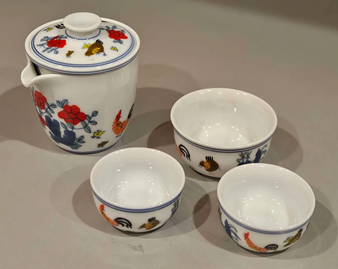
My tea set
When I got sick last November, I picked up a podcast to pass the time while I was stuck at home. It was a tea history podcast called… The Tea History Podcast by Laszlo Montogomery (he’s the same guy who does The China History Podcast!). One day, I looked at the thumbnail of the episode I was listening to and was surprised to see that it was one of my chicken teacups. What was it doing there? I listened very closely to this episode and learned about Jingdezhen, a town in China that produced porcelain for the imperial court, and I also learned that the chicken cup my tea set was based on was made there. The design that I had dismissed as an unremarkable modern invention was actually once a prized object sought after by emperors. Even now in 2014 one original chicken cup from the Ming dynasty was sold for 36 million dollars, making it one the top 5 most expensive Chinese porcelain wares sold at auction.
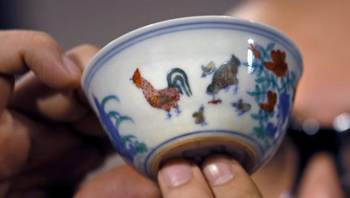
Ming Dynasty 'chicken cup' sells for record $36M
My interest peaked, I stumbled and fell into the surprisingly vast sea of porcelain history. It turns out the tale of how blue and white porcelain came to be is one that predates the Ming dynasty by about 600 years. Defined by a snow white body and a demure, not too light and not too dark shade of blue, it’s an iconic color combination that became immensely popular after the 1200s. If you search up Chinese porcelain, nearly every picture will be an example of it. They tend to look painfully old-fashioned yet undeniably elegant. How we got to Chinese porcelain is a long story though, and I would like describe a brief history of how it came to be:
9th century AD: An Arabian dhow sinks in the Java Sea between the islands that make up modern day Indonesia. It’s close to the Strait of Malacca, the crucial maritime trade network that connected Eastern Asia to the Middle East and Africa. Thousands of ceramics from China go down with it. Among them are blue and white plates thought to have been commissioned by merchants from the city of Basra, then part of the Abbasid Caliphate. The plates strongly resemble Islamic pottery from the same time period. This marked the beginning of Chinese blue and white porcelain, something that would take Chinese artisans centuries to master.
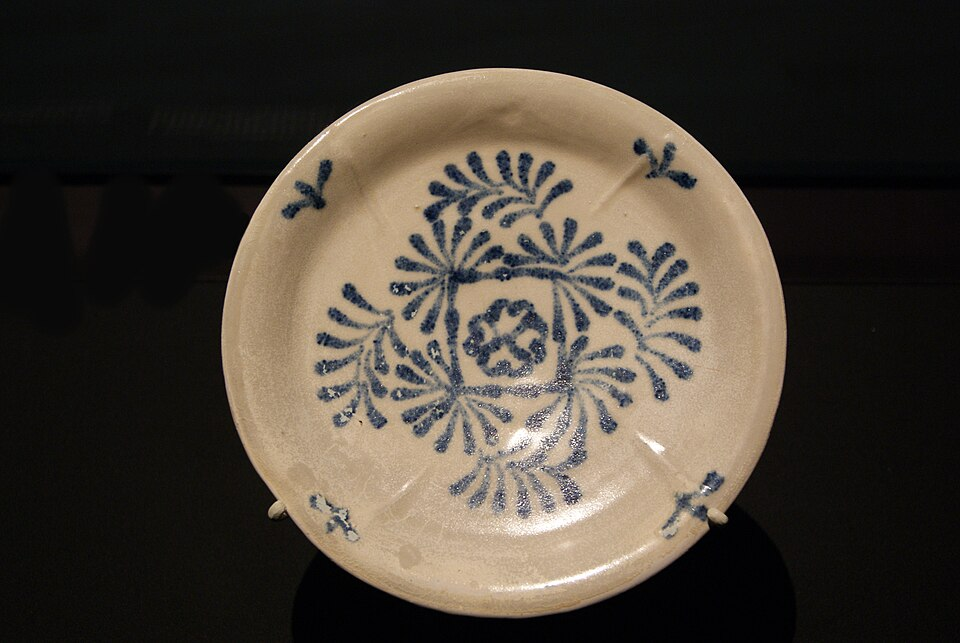
A Tang dynasty blue and white-ish plate recovered from the Belitung shipwreck, 9th century. Source
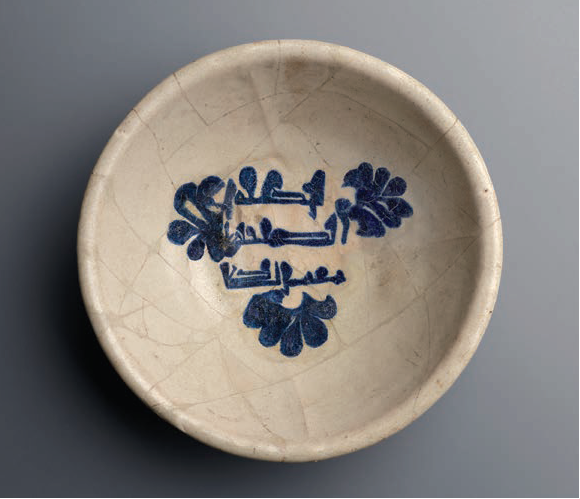
Abbasid era bowl from the Persian Gulf region, 9-10th century. Source
13th century AD: The Mongols invade China and wipe out the divided Western Xia, Jin, and Southern Song dynasties one by one. Under the Yuan dynasty and the greater Mongol Empire, trade flourished between China and the Middle East. Blue and white porcelain is made in Jingdezhen that resembles the later kinds and begins to be mass produced, mostly for export. However, because the Mongol rulers preferred it, it began to replace traditional jade-like celadon as the favorite porcelain of the imperial court.
15th century AD: During the Ming dynasty, using cobalt imported from Persia, Jingdezhen ceramists master the method of making blue and white pottery. In the centuries since the first Tang ceramic was sent westward, trade between the Middle East and China over land and sea had a quiet but unmistakable mutual influence on ceramics from both regions of the world. Artisans from the Middle East (most often Persia due to the proximity) emulated the porcelain from China while adapting them for local traditions like making the plates much larger, and Chinese artisans did the same, adopting Islamic motifs, inscriptions and colors instead of traditional Chinese designs. Though much of it was created for export to Europe or Ottoman and Safavid courts, inevitably some influences also seeped into domestic Chinese wares. Blue and white porcelain is the combination of both worlds. It was initially shunned by the Ming court because of its foreign associations but eventually they came around and it became immensely popular. At this point, Jingdezhen is a proto-industrialized town employing thousands of workers at the designated imperial kilns. One single palace order from 1433 called for 443,500 pieces of porcelain.
[Have a look! Between Sea and Sky: Blue and White Ceramics from Persia and Beyond at the Museum of Fine Arts, Houston - Arts of Asia and Chinese influences on Islamic pottery - Wikipedia]
1465-1487: The Chicken Cups are produced at Jingdezhen’s imperial kilns during the Chenghua Emperor’s reign. Interestingly, auction sites and wikipedia say they were originally made for drinking wine and no sources say they were originally for tea! I couldn’t find a reputable source to verify that though, so it could have just been a cup for sipping liquids in general.
1708: A German alchemist Johann Friedrich Böttger, finding no luck in trying to convert base metals to gold, turns to reverse engineering Chinese porcelain. After years of testing and help from an actual scientist, the two discover the secret to the unique whiteness and strength of Asian porcelain (called hard paste or true porcelain): a certain white clay called kaolin. Not wanting the rest of Europe to also learn how to make such profitable material, they keep it a secret and set up a factory in Germany to produce porcelain. The rest of Europe eventually uncovered the secret through their own testing and investigations to China, ending centuries of dependence on Asia.
2014: A Chicken Cup sells for 36 million USD, making it one of the most expensive Chinese porcelain pieces of all time to be sold at auction.
2025: I drink from a cheap replica and listen to a podcast.
While I was doing research, all this looking at Jingdezhen stirred a memory in me of staring in awe at a huge pile of porcelain sunflower seeds in the Seattle Art Museum last spring. Isn't this the town where Ai Wei Wei had them made? I found the same documentary that was playing in the museum and it was! In a two year long project that involved over 1600 people, Ai Wei Wei had 100 million porcelain sunflower seeds produced in the traditional way for his artwork Sunflower Seeds. The kaolin and china clay were ground to dust by waterwheel powered grinders, turned into paste, and poured into sunflower seed molds. Each seed was then hand painted by artisans who have been involved in porcelain making for generations. They worked on them in designated areas or at home in between doing chores and taking care of their children. Finally, the seeds are put in a kiln and baked at over 1800 degrees Fahrenheit to finish. That’s the abridged version. The full process takes over 30 steps. In interviews, the town’s workers said they liked the work because nowadays there isn’t much to do and some families have gone bankrupt. Most modern porcelain is created by machines in factories across China, churning out endless amounts to meet the still massive demand. You can now buy the exact teacups you want for a fraction of the cost and obsessing over antiques is something only really done by collectors and historians. And though not necessarily for the worse, the role of porcelain and the people who make it has no doubt changed. Ai Wei Wei’s message in Sunflower Seeds is filled with political and social commentary. To me, it tells the hidden story of the people of Jingdezhen, who continue to preserve the traditional methods of an era the world has moved on from.
All things that are popular will eventually be doomed to obscurity. But nothing exists in a vacuum. Every time I sit down to have tea, I think about the cultural exchange, labor, craftsmanship, and human experiences that needed to take place for me to sip tea from this knockoff Chicken Cup. It hits different now. Despite its flaws, it is a good cup for tea.
Sources Used:
https://www.sothebys.com/en/auctions/ecatalogue/2014/meiyintang-chicken-cup-hk0545/lot.1.html - a chicken cup’s auction page
https://www.bbc.com/news/entertainment-arts-26935113 - auction news
Muslim Blue, Chinese White: Islamic Calligraphy on Ming Blue-and-white Porcelain — Orientations - Great source on ming porcelain inscribed with islamic calligraphy and why they were there!
Real-Life Rumpelstiltskin | Lapham’s Quarterly story of the first european recreation of hard paste porcelain using kaolin
Between Sea and Sky: Blue and White Ceramics from Persia and Beyond at the Museum of Fine Arts, Houston - Arts of Asia persian white and blue ceramics and chinese influences
Ai Weiwei – Sunflower Seeds | Artist Interview | Tate documentary about Ai Wei Wei’s sunflower piece. Very cool watch!
Blue and white pottery - Wikipedia
Chicken Cup (Chenghua) - Wikipedia
Chinese influences on Islamic pottery - Wikipedia
