


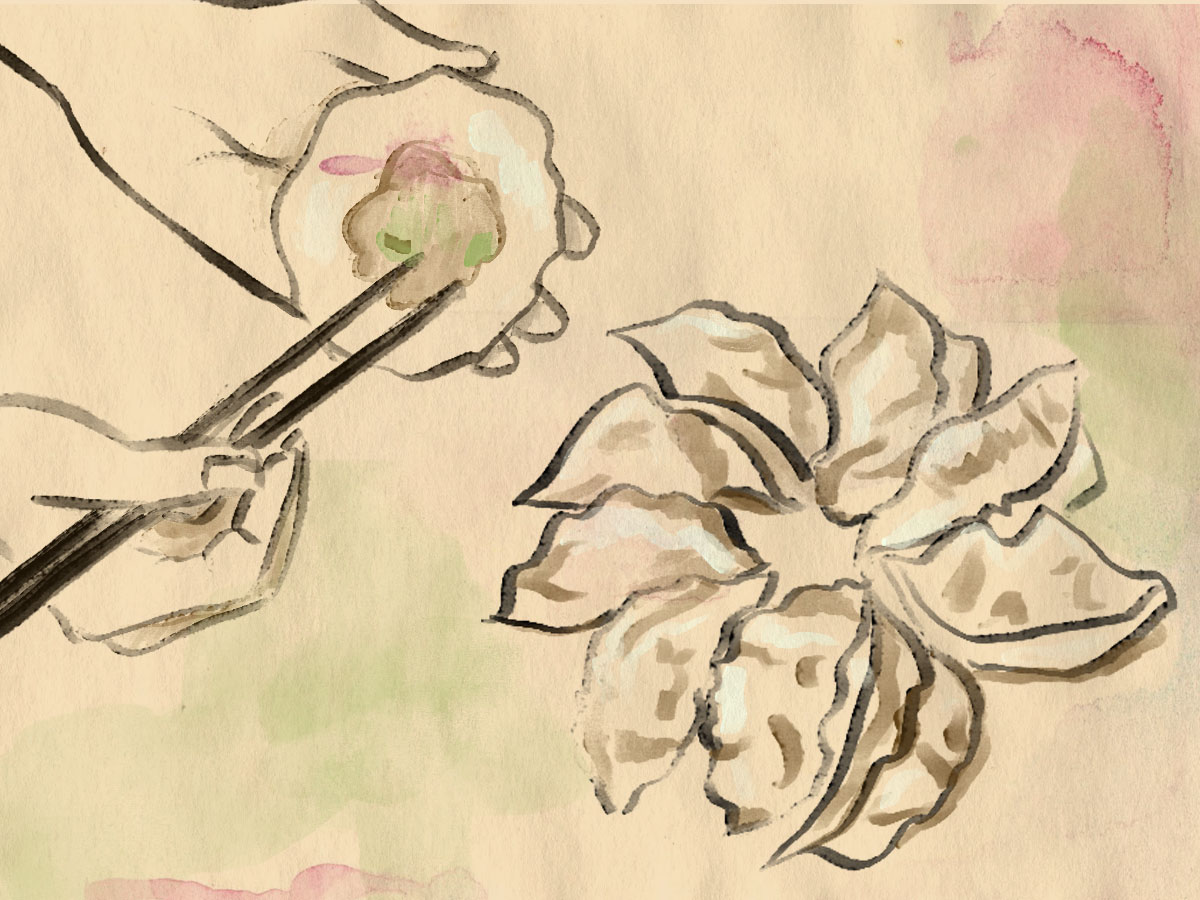
Dumplings. There’s something globally comforting about them: a soft wrapper of delicate dough enveloping a warm, hearty filling. The dumpling’s magic comes from the surprises that they hide; whether the wrapper cradles a savory mouthful of pork and mushroom or a sweet pocket of custard won’t be revealed until you’ve taken a bite. They can be steamed to a cloudy softness, boiled in soup for added flavor, or fried to a golden crisp, depending on one’s mood. A fundamentally basic dish that can be modified in essentially any way, it’s a perfect staple in every culture.
In the modern day, we see new twists on the traditional dumpling making their way into mainstream Western cuisine, perhaps the most famous of which being Din Tai Fung’s chocolate and mochi 小籠包 (xiǎolóngbāo; steamed soup dumplings). This particular recipe has reached viral popularity online, with thousands of creators posting videos raving over the decadent treat. To me, this feels like a testament to the dumpling’s longevity, as continuing innovations in flavors and textures allow them to be integrated into the comfort food of cultures all over the globe. While their persistence and variation around the world can be attributed to trade and the subsequent intermeshing of ethnic cuisines across time, I prefer to think of them as something so inherently loveable that each country couldn’t help but want to invent a little envelope of their own.
Some of my fondest memories with my grandmother involve making 馄饨 (húntún; wontons). Ground pork, shrimp, and green onions are combined with soy sauce and sesame oil to create the moist filling. Square wrappers pulled from her never-ending stash in the fridge are doled out between herself, my sister, and me. We carefully scoop little globs of the pink mixture into the center of the wrapper, dampen the edges with a little cornstarch and water slurry, and press the corners together to enclose the filling within a little triangle. The two ends of the triangle are then brought together and glued down with more slurry to form a sealed package.
My grandmother insisted on them being able to stand on their own, which was always a challenge for me. The filling-to-wrapper ratio had to be just right to achieve this, as you had to add enough pork to create a solid base for the wonton to rest upon, but not so much to where it burst out the sides when cooking. I could never seem to get these proportions quite right — I would overfill one and then underfill the next, creating a row of lopsided wontons nestled alongside her perfectly identical ones.
Although mine were far from flawless, each was still a 馄饨 nonetheless, a piece of precious memorabilia from our shared afternoon. I find it really beautiful that millions of kids around the world have had this same experience in their own kitchens, creating similar memories tied to this reconnection with their heritage. Whether they were learning to shape 馄饨, 만두, چۆچۈرە, or пельмени, the fundamental process remains the same: a careful hand enclosing a homemade filling within a fragile wrapper in hopes of creating the perfect parcel that survives the cooking process.
In an age of such discourse and disconnect, it can often feel as if we are floating around the world as lone individuals. Despite this, we can be reminded of our shared humanity through this language of food, one that transcends cultural boundaries and wraps us together in even the most trying of times. The dumpling is a vital component of this language, a staple recipe whose essence persists throughout all of its global guises. In my eyes, the continual adaptation of the dumpling into countless cultures is poetic, as it serves to remind us that our most comforting traditions are best when shared.
