


What is a flood myth?
You may have heard of the story of Noah’s Ark, where all the animals marched two-by-two onto a boat. Or, if you’re familiar with Hindu mythology, you may have heard of Vishnu and his matsya avatar. Chances are, you’ve heard of the term flood myth before, or at least actually heard a particular flood myth itself. But let’s back up; what exactly is a flood myth?
At their most literal, “flood myths” are stories wherein there is a flood. Often, these floods wash out the world as we know it, sometimes as a divine punishment, sometimes not. Many are etiological, meaning they explain why something in the world is the way it is; for example, the Greek myth of Persephone and her time in the Underworld explains the presence of seasons.
Some define flood myths strictly as legends where the flood wipes out almost everyone, akin to Noah and his Ark from the Bible. For this article, I will not be restricting flood myths to this definition, and will not place any limitations on the stories I include beyond, “stories originating in Asia featuring a flood.”
Flood myths can be found all across the world, especially in Asia. One of the earliest flood myths can be found within the Epic of Gilgamesh. Another, within the Vedas texts. In what would become China, stories were told of Yu the Great and his ability to tame floods. Countless more flood myths have been told, with differing degrees of fantasy and realism. What these stories say can tell us modern scholars valuable information about the cultures they come from, the circumstances that birthed them, and numerous other knowledge.
*As a preface, all of these stories have variations based on region, method, and countless other factors. I am not claiming these to be the ‘only’ or ‘correct’ tellings of these stories, only a version of the myth I have come across thanks to my sources.
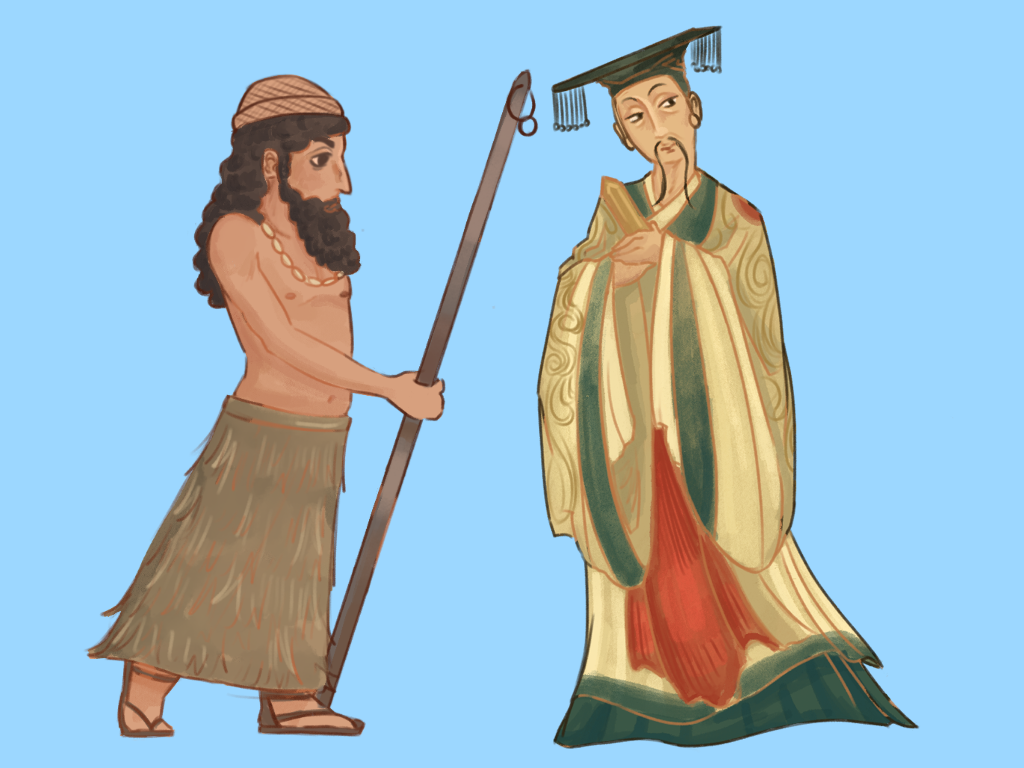
Utnapishtim, the Immortal Man
Hailing from the oldest civilization in the world, the Epic of Gilgamesh is a Mesopotamian story inscribed on clay tablets. It is also one of the oldest instances of extended writing. It depicts the exploits of the titular character Gilgamesh, a Sumerian king who undergoes a series of tribulations with the gods over his habit of kidnapping and violating women and his exploits against the gods. (Carey)
Towards the end of the tale, Gilgamesh meets Utnapishtim, the immortal man who, alongside his wife, was the only man to survive a great flood by building a boat. Like Noah, Utnapishtim filled his boat with as many living things as he could. Unfortunately, Enlil, the god who had caused the flood, found the boat and was angered. “‘Has some living soul escaped? No man was to survive the destruction!’” (Speiser) Ea, the god who told Utnapishtim to build the boat, tells Enlil that Utnapishtim deserved to live for his good character in building the boat and saving as many living things as possible. Perhaps to mollify Enlil, Utnapishtim and his wife thereafter were deified by Ea, making them technically no longer ‘man’ in the mortal sense.
Upon meeting Utnapishtim, Gilgamesh tells him about his previous adventures, particularly that of the loss of his friend Enkidu. Utnapishtim tells Gilgamesh that all things must die, that death is a part of life. (Spatt) After telling Gilgamesh his own tale of the great flood, Gilgamesh continues attempting to achieve immortality. He fails, and returns home.
The first man; Manu
One of the eighteen Mahapuranas, the Matsya Purana is the Hindu story of a great flood featuring the first of the god Vishnu’s avatars. In Hindu mythology, King Manu is often spoken of as the first human and progenitor of the human race. This flood myth sees the god Vishnu in his matsya (literally meaning fish) avatar warning Manu of the great flood, urging him to build a boat and fill it with two of every animal and seeds of every plant. (Gadhavi, p. 7143)
Like the Epic of Gilgamesh, morality and character once again plays a role in our male lead’s selection as the only man to survive the flood. Manu first finds Vishnu in the form of horned fish small enough to fit in a bowl of water. The fish, named Matsya, asks Manu to protect it from the bigger fish in the river. Manu takes the fish home and puts it in a bowl of water. This works for a time, until the fish grows too big for the bowl, so Manu gives it a pitcher. This too becomes too small, and Manu gives the fish a well. This continues until only the ocean is big enough to house the horned fish.
Some tellings vary with how Matsya warns Manu of the flood. Some say that Manu visits the fish in the ocean regularly, when one day, the fish warns Manu of a great flood coming and tells him to construct a boat big enough to carry all the living species of the world with a rope attached to the bow. (Berger) Some say that Manu, realizing that such a large fish is surely more than just a fish, prayed to the gods to reveal to him the fish’s true form. The fish then revealed itself to be Vasudeva, or Vishnu, or another related figure, then warned Manu of the flood. (Chand, p. 133) When the waters rise and the flood begins, the fish guides the boat through the floods with the rope tied to its horn.
The emperor who tamed the floods: Yu the Great
Within modern historical academia, we know that Chinese dynasties reach at least as far back as 1045 BCE with the Western Zhou dynasty. There is evidence from oracle bones of civilizations even further back. Born out of the legends of this time is the mythical Emperor Yu, also known as Yu the Great, who is believed to have established the mythical Xia dynasty.
Yu’s flood myth is also the story where he becomes emperor. Now. There are so, so many variations of this story I honestly don’t know where to begin. So instead, I’ll summarize the important bits like I have for the other two stories, but with even less detail.
By some means or method, Yu curtails the floods destroying China’s fields and homes. In some stories, he does so on the back of a dragon with massive piles of dirt, laying the earth down so that it reroutes the water. (Fleischmann) In others, he does this by much more ordinary methods; manually digging and carving canals over many, many years.
Here, we find more interaction with nature. So entwined with nature is Yu’s story that the scholar and philosopher Mencius comments on Yu’s ability to understand nature’s principles and work with them to ‘tame’ the floods. “Yet the hydraulic method is not posited as the sole reason for Yui's success. It is based on Yi's innate knowledge and understanding of the princi-ples of nature… [the] context [of this explanation] is a dialogue between Mencius and a reputed expert on water control, Po Kuei. Its theme is the unnatural versus "the natural", which Mencius terms the Tao.” (Birrell, p. 245)
Kindness and working with nature
A common element among flood myths is the drastic, almost generational damage the event causes. Some theorize that this is because many of these instances stem from climate change after ice ages, especially the most recent one roughly 11,000 years ago. Such upheaval of the land and agricultural periods would have devastated many peoples. We see smaller versions of these fears within China, where overflooding, underflooding, or flooding at the wrong time of the Yellow and Yangtze Rivers would set the tone for years. People in many parts of Asia depended on consistent flooding of fields for crop harvests, and disruption could mean decreased food, as well as the usual physical effects of washed away homes and other land elements. Whether or not even a large chunk of flood myths stem from post-ice age floods is yet to be proven. Some researchers theorize that some flood myths correlate to different ice ages, to the melting of specific, unrelated snowbanks, or to large-scale tsunamis that wiped out coastlines. Unfortunately, the answer as of right now is, ‘it depends’.
Although what ‘scientific’ information we can glean from these stories is difficult at best to ascertain, there is much we can derive from the commonalities in the messages they share. Utnapishtim, despite his own immortality, expresses that death is the natural way of the world. The Mesopotamian flood myth asks the audience to accept the natural order of things, the natural cycle of life. Manu is only able to save himself and the plants and animals of the world because of his kindness towards a little fish. The Hindu flood myth reminds the listener to show kindness to small pieces of nature. Yu’s routing of the rivers was explained by contemporary philosophers as due to Yu working with nature. It is extremely fitting that these stories of great environmental change (that may have been born of trauma caused by natural disasters) emphasize the inherent mortality of life and relationships between humans and nature.
Bibliography
Ataç, Mehmet-Ali. “The Flood Myth as Paradigm.” Chapter. In Art and Immortality in the Ancient Near East, 81–101. Cambridge: Cambridge University Press, 2018.
Berger, Adam. “Matsya and the Great Flood: Religion and Philosophy: Research Starters: EBSCO Research.” Matsya and the Great Flood, 2021. https://www.ebsco.com/research-starters/religion-and-philosophy/matsya-and-great-flood.
Birrell, Anne. “The Four Flood Myth Traditions of Classical China.” T’oung Pao 83, no. 4/5 (1997): 213–59. http://www.jstor.org/stable/4528727.
Carey, John. “The Epic of Gilgamesh.” Essay. In A Little History of Poetry. Little Histories. Yale University Press, 2020.
Chand, Ankita. “Great Flood Stories: Inter-Religion Similarities.” International Journal of History 2023; 5(1): 132-135, April 19, 2023. https://www.historyjournal.net/article/206/5-1-30-784.pdf.
Fleischmann, T. “Yu Rebuilds the Earth: History: Research Starters: EBSCO Research.” Yu Rebuilds the Earth, 2021. https://www.ebsco.com/research-starters/history/yu-rebuilds-earth.
Gadhavi, Himeshkumar Dineshbhai. “The Incarnation of Matsya of Lord Vishnu and Denotation to the Mythology, Symbolism of Ecological Study and Legacy of Hinduism.” Educational Administration Theory and Practice, January 18, 2024, 7413–15. https://doi.org/10.53555/kuey.v30i1.10595.
Montgomery, David R. “Emperor Yu’s Great Flood | Science.” Science - Vol 353, Issue 6299, August 5, 2016. https://www.science.org/doi/10.1126/science.aah4040.
Spatt, Hartley S. “The Gilgamesh Epic: Literature and Writing: Research Starters: EBSCO Research.” The Gilgamesh Epic, 2023. https://www.ebsco.com/research-starters/literature-and-writing/gilgamesh-epic.
(Trans.) E. A. Speiser, in Ancient Near Eastern Texts (Princeton, 1950), pp. 60-72, as reprinted in Isaac Mendelsohn (ed.), Religions of the Ancient Near East, Library of Religion paperbook series (New York, 1955). PP. 100-6; notes by Mendelsohn
